Report 52 is the 2024 NSW Legislative Council inquiry into children and young people with disability in education. This guide goes through the evidence chapter by chapter: suspensions, restraint and seclusion, enrolment gatekeeping, children out of school, the workforce, complaints and the NDIS. It lists all 28 recommendations with the government’s answer to each, and the suspension data since. Most figures are evidence the committee heard. Where something is the committee’s own finding, it says so.
This is the long version. If you want five minutes rather than twenty, start with the summary.
A quick note on how to read it. Most of the numbers below are evidence the committee heard, from submissions, surveys and witnesses. I’ve said who said what. Where something is the committee’s own finding, I’ve said that too. Paragraph and page numbers are from the report, so you can check every line yourself.
1. Who ran it and why it matters
The inquiry was run by Portfolio Committee No. 3 (Education) of the NSW Legislative Council, chaired by Abigail Boyd MLC. It covered early childhood education, public, Catholic and independent schools, TAFE and universities. Report 52 was tabled on 22 August 2024 with 20 findings and 28 recommendations.
In 2024 about one in five NSW public school students, 20.4%, were counted as students with disability receiving supplementary, substantial or extensive adjustments. This is not about a few kids at the back of the room.
2. Suspensions and exclusion
- In Semester 1 2022, students with disability were about 18% of enrolments and 50% of suspensions (para 2.50).
- Exclusionary discipline was being used on children “as young as five years old” (para 2.13).
- One parent said their child had been suspended more than 10 times in three school terms, for behaviour that “was a direct result of their disability” (para 2.19). A single parent lost their job after three suspensions (para 1.4).
- The inquiry heard that home schooling registrations had risen 37% (para 2.45), and that an Autism Awareness Australia survey found 43% of autistic children were refusing school weekly (para 2.16).
When your kid is suspended, they don’t stop being your responsibility. They come home, and someone stops working.
3. Restraint and seclusion
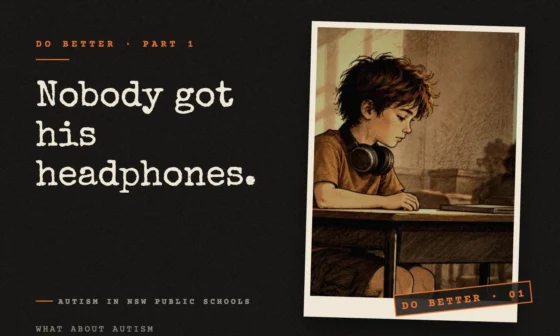
Restrictive practices means things like physically holding a child, locking them in a room or taking away something they need. The case most people remember: a nine-year-old with autism and ADHD whose plan said he needed noise-cancelling headphones. He didn’t get them in a fire drill. The inquiry heard he was “pinned down by four or five schoolteachers”, secluded for about 20 minutes, then suspended (para 2.14).
The Chair’s draft recommended phasing restrictive practices out. The committee minutes show the final recommendation was changed to monitoring them “with a view to reducing” their use. The government supported that in principle (Recommendation 3).
4. The gate: enrolment and gatekeeping
- In a national survey of 745 families, 70% said they had experienced gatekeeping: being refused, discouraged, steered elsewhere or offered part-time hours only (para 5.23).
- One parent told the inquiry: “I was made to feel like I was nearly an abusive parent” to keep their son at school (para 1.3).
- Anti-Discrimination NSW told the inquiry NSW is the only Australian jurisdiction where private schools can lawfully discriminate against students with disability. The exception dates from 1981 (para 3.75).
The committee recommended removing that exception (Recommendation 24). The government supported it, and referred it to the NSW Law Reform Commission’s review of the Anti-Discrimination Act. The Chair’s draft had recommended amending the Act directly.
5. The children nobody counts
The committee’s own finding: an “unquantified number” of children with disability are not in school at all (Finding 9). The Department told the inquiry there is no system to identify children who are not enrolled anywhere (para 4.62). One 15-year-old had not attended a full day of school in more than two and a half years.
6. Who’s in the room: the workforce
- About one-third of staff in special education roles hold a special education qualification (para 4.89).
- There were nearly 500 vacant specialist teaching positions (para 6.34).
- School leaders receive about 4.5 hours of disability training every three years (para 4.96).
- There is roughly one school psychologist per 1,500 students (para 6.58).
I don’t blame teachers for this. They were never given the training, and then they’re handed my son. A carer told the inquiry her non-verbal daughter was “constantly aged down”. Not speaking is not the same as not understanding.
7. Complaints and oversight
In a Vision Australia survey, 80% of people who complained said the complaint was not resolved (para 6.128). Mediation is non-binding (para 6.130). The committee described the complaints process as “severely inappropriate” (para 6.198) and recommended an independent oversight body covering every education setting (Recommendation 23).
That was the only recommendation the government did not support.
8. The NDIS and therapy at school
NDIS rules exclude supports that are the education system’s responsibility (para 3.9). The result is a patchwork. Some schools reported up to 180 providers a week, while others allowed no therapy in Terms 1 or 4, or “only 5 minute visits” (para 6.114). Some parents were told to use NDIS funds to pay for school camp (para 6.99).
9. What works
It’s not all bad, and the report says so. A Year 7 student joined a dance class, and “the whole year-9 cohort joined in”. A teacher told a parent: “I haven’t taught your child. She has taught me.” None of this is impossible. It’s a choice someone makes.
10. All 28 recommendations, and what the government said
The government’s response, released in November 2024, supported 7, supported 13 in principle, noted 7 and did not support 1. “Supported in principle” usually means the government agrees with the idea but hasn’t committed to a specific action or timeline. “Noted” means it acknowledged the recommendation without agreeing to act on it.
| # | Recommendation (summarised) | Government |
|---|---|---|
| 1 | More distance education funding for students with disability in out-of-home care | Noted |
| 2 | Best-practice communication between schools, students, families and siblings | In principle |
| 3 | Monitor restrictive practices in schools, aiming to reduce them | In principle |
| 4 | Trauma-informed behaviour support, and fewer suspensions and expulsions through teacher training | In principle |
| 5 | Better support for children returning to school after exclusion | In principle |
| 6 | Move towards inclusive mainstream schooling where the child and family want it | In principle |
| 7 | Lift disability content in initial teacher education accreditation | In principle |
| 8 | Longer, more frequent and better mandatory disability training for teachers | Noted |
| 9 | More incentives for teachers to get postgraduate special education qualifications | In principle |
| 10 | Fund permanent full-time learning and support teachers in mainstream schools | Noted |
| 11 | More qualified Deaf teachers, and an inclusive education capability framework | Supported |
| 12 | More specialist vision teachers for blind and low vision students | Supported |
| 13 | More people with disability working as teachers and support staff | In principle |
| 14 | Culturally safe policies for First Nations students with disability | Supported |
| 15 | Incentives for learning support officers to gain Certificate III/IV qualifications | Noted |
| 16 | Invest in specialist and allied health workforces | Supported |
| 17 | Base Integration Funding on functional assessment, not diagnosis | In principle |
| 18 | Inclusive design in school buildings, putting access ahead of heritage | In principle |
| 19 | Long-term investment in educational infrastructure | Supported |
| 20 | Clear guidelines for schools on reasonable adjustments | In principle |
| 21 | Streamline HSC disability provisions | Supported |
| 22 | Help schools work with parents and NDIS providers | Noted |
| 23 | An independent oversight body for children with disability in education | Not supported |
| 24 | Remove the exemptions that let private institutions discriminate on disability | Supported |
| 25 | A positive duty on education providers to make reasonable adjustments | Noted |
| 26 | Better data collection and reporting on students with disability | In principle |
| 27 | Support transitions from school to TAFE, VET and university | In principle |
| 28 | Review university governance on disability | Noted |
11. What’s happened since
The Department of Education’s fact sheet for the 2024 school year, the year the report was tabled, shows:
- 44,924 suspensions of students with disability, involving 20,194 students.
- 2,037 of those students were in Kindergarten to Year 2, with 4,083 suspensions between them.
- A suspension rate of 13.1% for students with disability, against 10.9% in 2023. The Department warns that 2024 isn’t directly comparable with earlier years because the policy changed.
- The new Student Behaviour Policy, from Term 1 2024, removed the cap on the number of suspensions a student can receive in a calendar year. Caps on total suspension days still apply: 30 school days for K to 2, and 45 for Years 3 to 12, unless approved.
Where I land
I read all of it because Eden can’t come home and tell me about his day. Most of what’s in this report, he’d never be able to report himself. That’s why oversight matters to families like mine, and why the one recommendation they said no to is the one I keep coming back to.
Our kids aren’t broken. The system is. Read the report, ask your school the hard questions, and share this with someone who’s never had to think about it.
Worth knowing
Report 52, NSW Legislative Council Portfolio Committee No. 3 (Education).
Media releaseof suspensions in Semester 1 2022 went to students with disability, who were 18% of students.
Para 2.50teachers pinned down a nine-year-old denied his headphones in a fire drill.
Para 2.14of 745 families surveyed had experienced gatekeeping.
Para 5.23an “unquantified number” of children with disability are not in school.
Finding 9of disability training for school leaders every three years.
Para 4.96of complainants in one survey said their complaint was not resolved.
Para 6.128K–2 students with disability were suspended in 2024.
NSW DoE fact sheetSupported, in principle, noted, not supported.
Govt responseQuestions worth asking your school
- What adjustments are in place for my child?Ask to see them in writing, and how they’re reviewed.
- What happens before a suspension is considered?Ask what supports and adjustments are tried first, and how you’ll be involved.
- Is a restrictive practice ever used with my child?Ask how it’s planned, authorised and recorded, and how you’ll be told.
- Who has disability training here?Ask who has special education qualifications and who you can talk to.
- How do I raise a concern, and who reviews it?Ask what happens if you’re not happy with the school’s answer.
Questions people ask
What is Report 52 about?
Report 52 is the NSW Legislative Council inquiry into children and young people with disability in NSW educational settings, from early childhood to university. It was tabled on 22 August 2024 with 20 findings and 28 recommendations.
Which recommendation did the NSW Government reject?
Recommendation 23, an independent oversight body for children with disability in education. It was the only recommendation the government did not support.
How many students with disability were suspended in NSW in 2024?
The NSW Department of Education reported 44,924 suspensions of students with disability in 2024, involving 20,194 students, including 2,037 students in Kindergarten to Year 2.
Did NSW remove the cap on suspensions?
Under the Student Behaviour Policy introduced in Term 1 2024, the cap on the number of suspensions a student can receive in a calendar year was removed. Caps on total suspension days remain: 30 school days for K–2 and 45 for Years 3–12, unless approved.
What are restrictive practices in schools?
Practices that restrict a student’s movement or freedom, such as physical restraint or seclusion. Report 52 recommended monitoring them with a view to reducing their use, which the government supported in principle.
Keep reading
Follow our story
If this meant something to you, the best thing you can do is subscribe and share it with someone who has never lived with autism. That is who I am making this for.
Sources
- NSW Legislative Council, Portfolio Committee No. 3 (Education), Children and young people with disability in New South Wales educational settings, Report 52 (22 August 2024). Paragraph and page references in this post are to this report.
- NSW Government, Government response to Report 52 (November 2024).
- NSW Department of Education, 2024 full year suspensions and expulsions fact sheet.
- NSW Legislative Council, media release: report tabled (22 August 2024).