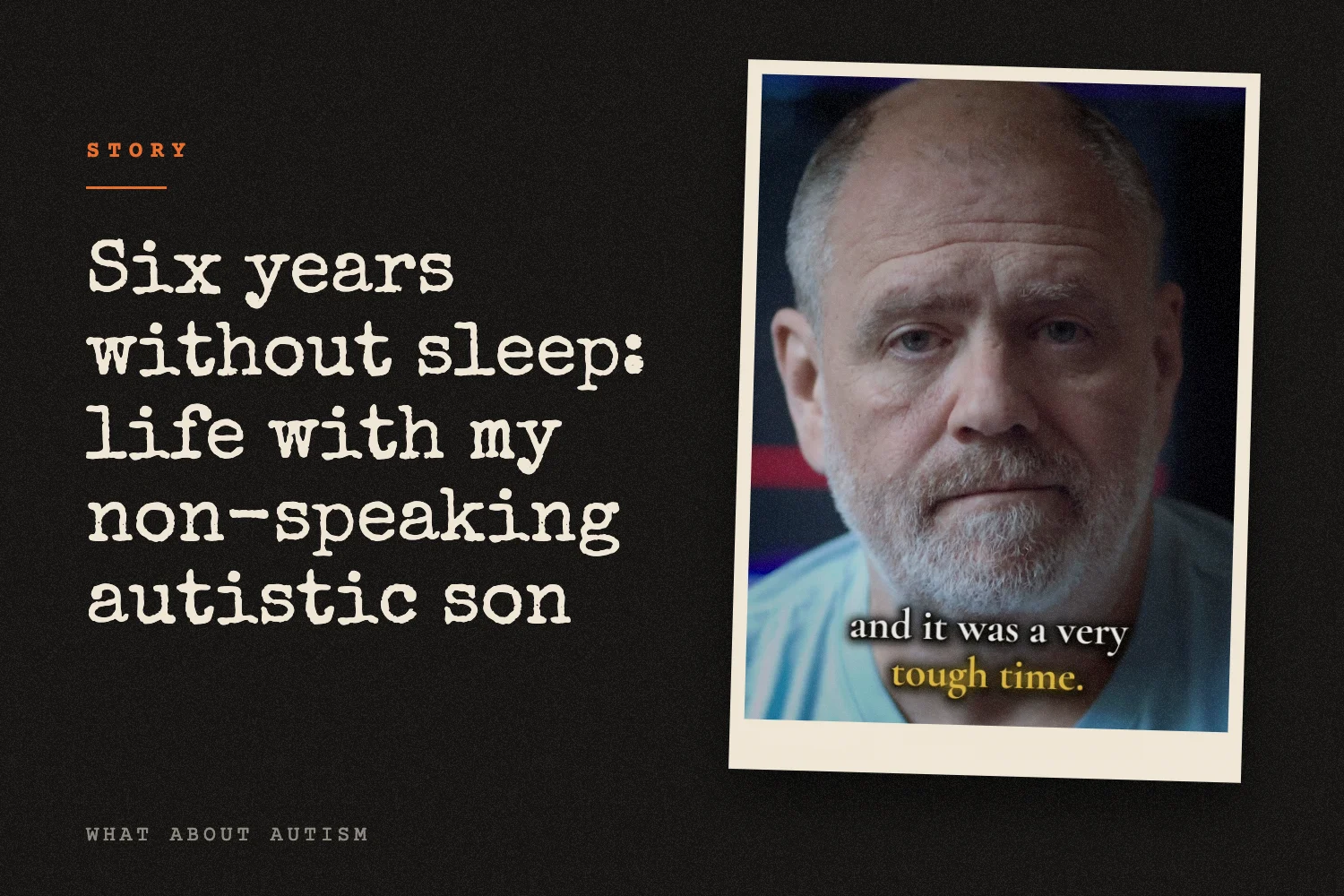
From about age three until nine, my son Eden, who is autistic and non-speaking, woke at 1am most nights and didn’t go back to sleep. My wife Michelle and I both stayed up with him for six years while running two businesses. Sleep problems are common in autistic children: studies put it at 50 to 80 per cent.
1am. Every night. For six years.
What it looked like
From about three until about nine, Eden would wake at one in the morning and not go back to sleep. He’d be exhausted too. He just couldn’t stop.
Michelle and I would both stay up with him. We felt guilty for each other. Neither of us wanted to leave the other one alone with it.
All the while, we were trying to run two businesses on no sleep.
What it cost
The stress of it put me in hospital with my Crohn’s disease. That left Michelle to handle all of it on her own.
That’s the part people don’t see. It isn’t just tiredness. It’s your health, your work, your marriage, all running on empty at the same time, with no end date.
If this is your house right now
You’re not the only one. And it’s not a parenting failure. Sleep problems are part of autism for a lot of kids.
Tell me in the comments on YouTube what your 3am looks like. Sometimes it helps just to know someone else is awake too.
Worth knowing
of autistic children have sleep problems, compared with fewer than half of other children. Night waking is one of the most common.
Chen et al., 2021Mothers of autistic adolescents and adults in a US study reported fatigue on 50% of days, double the comparison group’s 25%.
Smith et al., 2010of Australian carers surveyed in 2024 reported high or very high psychological distress.
AIHW, 2025What I’d tell my younger self
- Push for help with sleepTalk to your GP or paediatrician, and if you don’t get anywhere, ask again or see someone else. Sleep is a health issue, not a phase you just wait out.
- Ask other parentsSome of the most useful advice we ever got came from another parent, not a professional.
- Take turns if you canWe both stayed up out of guilt. Two exhausted parents are worse than one rested one.
Questions people ask
Do autistic children have more sleep problems?
Yes. Research summaries put sleep problems at 50 to 80 per cent of autistic children, compared with under half of typically developing children. Common problems include trouble falling asleep, short sleep and waking during the night.
What should I do if my autistic child won't sleep?
Start with your GP or paediatrician and keep a simple sleep diary. Keep the bedroom calm, dark and predictable. If the advice isn’t helping, it’s okay to ask for a referral or a second opinion.
Keep reading
Follow our story
If this meant something to you, the best thing you can do is subscribe and share it with someone who has never lived with autism. That is who I am making this for.
This is our family’s experience, not medical advice.
Sources
- Chen H et al., Sleep problems in children with autism spectrum disorder, BMC Psychiatry, 2021 (summarising earlier studies).
- Smith LE et al., Daily experiences among mothers of adolescents and adults with autism spectrum disorder, J Autism Dev Disord, 2010 (US study).
- Australian Institute of Health and Welfare, Informal carers (October 2025).